Scope
The Dominance Rule in this article discusses the rule that disambiguates the name resolution in a virtual inheritance in C++.
Dominance Rule
In a multiple inheritance hierarchy it's possible to have ambiguous meanings to a name(object, function, typedef or enumerator), visible through an inheritance graph. This problem creeps its head irrespective of the inheritance being virtual or non-virtual, unless of course dominance comes as a saviour.
Dominance states that a name resolution in an inheritance hierachy goes bottom up and the specificity is determined by the dynamic type of the object refering the name. In other words a name is dominanting if its defined in both the classes where one class derives from the other, and the one in the derived class dominates.
Case I: In a multiple inheritance scenario where only one of the derived classes B overrides the base class identifier 'name', the definition is available in the most derived object D through two different paths. The first definition is that from the derived class B that overrides the base class A's definition, and the second from the base class A through the alternate path. Here the lookup for 'name is ambiguous as B::name doesn't dominate A::name in the base class C.
on one path but not on the other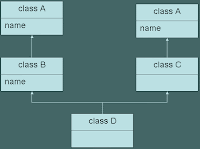
Case II: In a virtual inheritance scenario where both the derived classes B and C overrides the base class identifier 'name' definition, the same is available in the most derived object D through two different paths. The again is ambiguous.
hides A::name on respective paths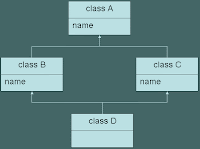
Case III: Let's consider the case where dominance comes into play. If the scenario in Case I was that of virtual inheritance then the definition of B::name would dominate that of A::name coming from a single shared subobject A. Hence the access would not be ambiguous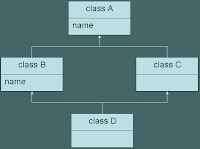
Dominance needs care
Dominance can indeed play a spoil sport if not heeded to. Consider the code snippet below.class A
{
public:
int x;
typedef int y;
};
class B : public virtual A
{
public:
typedef int x;
int y;
};
class C : public B, public virtual A
{
public:
x y; // Works fine as B::x dominates A::x
// so x acts as typdef, and the
// statement as a declaration.
y x; // Error: Flagged as a compile time error
// as B::y dominates A::y and hence y
// is interpreted as an integer.
};
References
[1] Dominance Rule - MSDN
[2] C++ Gotcha #79 - Dominance Issues
Thursday, April 3, 2008
The Dominance Rule
No dominance: B::name hides A::name
This is ambiguous as B::name and C::name
B::name dominates A::name

Subscribe to:
Post Comments (Atom)

What people said... (0)
Post a Comment